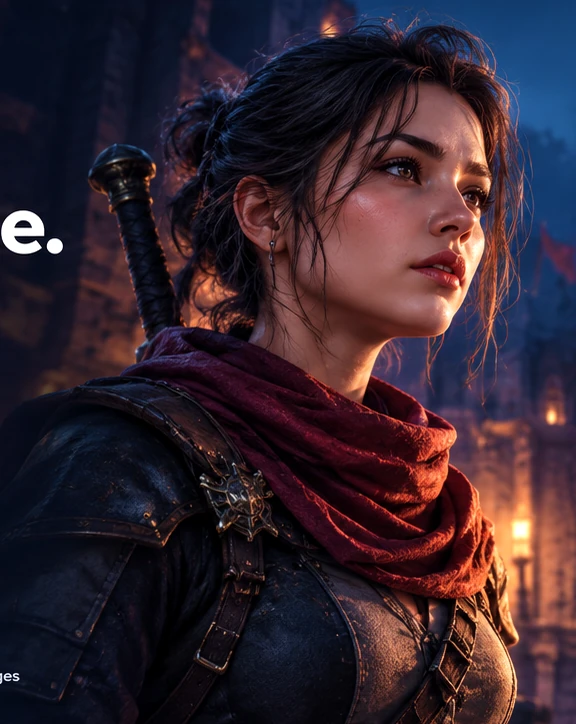
Imagine your game characters speaking Spanish, French, or Japanese — without starting voice production from scratch each time.
SceneVoice is being designed to help game makers translate dialogue, create character voice recordings, and keep everything updated when the script changes.
Don't just read about SceneVoice. Hear what it means.
These short AI-generated sample recordings show what multilingual dialogue and simple script changes can sound like. Press play to listen.
♫Real playable recordingsListen to our multilingual voice examples.
DEMO 01ONE CHARACTER · FOUR LANGUAGES
Same scene. Different languages.
Imagine a hero in your game saying the same line to players around the world. Choose a language and listen.
✦
GAME CHARACTER · THE WARRIOR“We need to leave. Now!”
Choose a language to hear the recording.
DEMO 02ONE SMALL SCRIPT CHANGE
Change a line. Update the voice.
A developer changes the meaning of one sentence. Hear the old and new recordings and see why tracking revisions matters.
BEFORE · OLD LINE“Open the door!”
↓
AFTER · SCRIPT UPDATED“Don't open the door!”
✓
SceneVoice is designed to find the affected recordings, so a studio doesn't have to redo every line.
Sample voices demonstrate the intended experience. Final translations and audio are reviewed before use.
ONE IDEA, EXPLAINED SIMPLY✦ A game has characters✦ Characters have dialogue✦ SceneVoice helps them speak more languages
01 / THE CHALLENGE
Your story deserves to be heard everywhere.
Every game character needs dialogue. To make the game available in other countries, someone must translate the words and record the voices — often again when the story changes.
ENGLISH GAME SCRIPT
001 Help me!
002 Open the gate!
003 We're out of time!
004 Follow me!
FRENCH / SPANISH / GERMAN
Translate every line…
Find voice actors…
Record every line…
Repeat after revisions…
Hundreds of files. Lots of repeated work.
01
So many lines to translate
A game may have thousands of spoken lines, each needing careful translation.
02
Voices need recording, too
Each character needs speech in the languages the studio wants to support.
03
One small edit creates more work
When a line changes, teams need to find and fix the affected translations and recordings.
02 / OUR SOLUTION
What if all of that happened in one place?
SceneVoice brings the steps together so a game studio can focus on the story — while AI helps with the repetitive production work.
🌐
Translate the words
Turn one game script into draft dialogue in several languages.
🎙️
Create character voices
Generate spoken lines using permitted AI voices, ready for review.
↻
Keep lines up to date
When dialogue changes, spot which versions and recordings need attention.
SceneVoice is in development.
03 / HOW IT WORKS
From a game script to voices in the game.
Six steps. No complicated technical knowledge needed.
Assign a licensed AI voice or an actor-authorized voice.
04
ENGLISH“Follow me!”SPANISH“¡Sígueme!”◖▂▆▃▇▅◗
Translate & make speech
AI prepares the translated words and spoken audio.
05
▶ Voice preview▂▄▆▃▇▅▂▆▄✓ Approved by reviewer
Listen & approve
Check the voice and translation before using them.
06
📁 GAME AUDIOmaya_es.wav ✓maya_fr.wav ✓maya_de.wav ✓
Download game audio
Get organized audio files ready to add to the game.
04 / WHY THIS MATTERS
Here's the part that saves teams from headaches.
Imagine your game developer changes just one sentence.
BEFORE · OLD SCRIPT“Open the door!”
→
AFTER · NEW SCRIPT“Don't open the door!”
SCENEVOICE FINDS WHAT NEEDS UPDATINGILLUSTRATIVE EXAMPLE
🇪🇸 Spanish↻ Recheck dialogue + audio
🇫🇷 French↻ Recheck dialogue + audio
🇩🇪 German↻ Recheck dialogue + audio
All unchanged lines✓ Keep approved versions
The important part: SceneVoice is designed to find the affected files instead of making the team search through everything manually.
05 / WHO IT'S FOR
Built for people who make games.
Whether you're a tiny indie studio or a team preparing a worldwide release, the problem is the same: the game's characters need to speak to players.
🎮
Indie game creators
Explore more languages without building an entire voice production department.
🏰
Game studios
Keep characters, dialogue versions, voice takes and approvals organized.
🌍
Localization teams
Review translations and track what changed between script versions.
06 / GPU USE CASE
Why does SceneVoice need GPU computing?
Because translating game dialogue and generating spoken character voices can create a very large amount of AI work. SceneVoice is being designed so that this work can run on NVIDIA GPU infrastructure and then return reviewed, game-ready audio.
🎙️ Speech generationSpoken lines for each character
↓
✅ Review & exportApproved audio files ready for the game
Translation at scale
One script can become dialogue in Spanish, French, German and more. GPU computing helps process large batches faster.
Speech generation at scale
Each translated line can become audio for a character voice. This can quickly turn into thousands of recordings.
Script changes without full rework
When a line changes, SceneVoice can update the affected dialogue and voice files instead of restarting the whole process.
Human review stays important
The goal is not to skip review. It is to speed up translation and speech generation, then let the team approve the results.
07 / HOW STUDIOS USE SCENEVOICE
From your game's dialogue file to dialogue playing inside the game.
SceneVoice by Games 4 Life is designed for the way game developers actually work. Start with a simple upload, or connect a future API to your studio's tools.
01 · PREPARE
📝
Write your game's lines
Keep each line's ID, speaker and scene in a CSV or JSON file.
GATE_014Maya: “Open the gate!”
02 · CREATE
🌍
Choose languages & voices
Set Spanish and French, then choose voices your studio has permission to use.
🇪🇸 Spanish 🇫🇷 French 🎙️ Maya's authorized voice
03 · REVIEW
🎧
Listen before approving
Review translated lines, pronunciation, emotion and length. Regenerate individual takes if needed.
✓ Approved by the team
04 · SHIP
🎮
Bring audio into the game
Export WAV files and a manifest that matches each recording to the original line ID.
audio/es/GATE_014.wav
🖥️
FOR SMALL TEAMS · WEB WORKSPACE
No code needed
Upload a dialogue CSV, pick languages, listen to generated takes and download a labeled audio package. Intended for indie developers and localization producers.
⌘
FOR ENGINEERING TEAMS · API
Connect your production pipeline
Send versioned dialogue batches, get a processing job ID, track review status and import approved recordings into Unity or Unreal through your own integration scripts.
DEVELOPER EXAMPLE · PROPOSED INTEGRATION
One dialogue line. A clear file to import.
Instead of guessing which audio belongs to which character, the proposed manifest preserves the exact dialogue ID, language, revision and WAV filename.
Leads Games 4 Life and the product direction for SceneVoice.
Kalimu
Developer
Works on the technology and engineering behind SceneVoice.
Anupoma Alam
UI/UX Designer
Designs a clear, approachable product experience for game makers.
SceneVoice is in development. Audio samples illustrate the planned experience.
COMPANY
Games 4 Life
An IT business based in Dhaka, Bangladesh, operating since 2021. SceneVoice is its planned product for game dialogue localization and voice production.
Trade license
TRAD/DNCC/017513/2024
Issued by
Dhaka North City Corporation
Business commenced
12 April 2021
License validity
Renewed for 2026–2027, valid through 30 June 2027
Business type
IT business
Business address
D-28/8 (4th Floor), Arambag Housing, Mirpur, Dhaka-1216, Bangladesh Zone 2 (Mirpur), Ward 5 · Dhaka North City Corporation
COMMON QUESTIONS
Still wondering how it works?
Does SceneVoice translate the whole game automatically?
The goal is to help translate game dialogue using AI. Human reviewers will still check meaning, names, tone and context before approval.
Does it replace all voice actors?
No. It is being designed for licensed AI voices and properly authorized voice references. Human performance, review and voice rights remain important.
What happens if we change the script?
SceneVoice is designed to identify the affected translations and audio takes, while keeping the approved versions of unchanged lines.
Can I use SceneVoice today?
SceneVoice is currently in development. Contact us to discuss pilot opportunities.
LET'S BUILD BETTER GAME LOCALIZATION
More players should understand your story.
Developing a game? We'd love to understand your localization challenges and discuss a future SceneVoice pilot.